How to Be a Great Software Engineer in 2026
The framework hasn't changed. The weight of each skill has.

Eighteen months ago, I wrote How to Be a Great Software Engineer. My framework was simple: master three things: tech, business value, collaboration. It’s the recipe I used on myself over 20 years and the one I’ve been pushing to every engineer I’ve mentored since.
Since then, I stopped writing code entirely. And then I went back to shipping it. Not because I missed typing, but because AI changed what “shipping” means. I’m a CEO who merges ten PRs a day, none of them written by hand. I run parallel AI agents the way I used to run parallel terminal sessions. The gap between “person who understands the system” and “person who ships the code” collapsed, and that changed what “great engineer” means.
The three aspects still hold. But the weight shifted.
Tech: from writing to reviewing
The original post said pull the strings, dig deep, understand everything you’re responsible for. That hasn’t changed. What changed is how you use that skill.
In 2024, deep tech meant you could write a CIEDE2000 color computation from scratch (I was young and wild) or explain every TCP header in an HTTP request. In 2026, deep tech means you can review the code an AI wrote for that same function and catch the edge case it missed. The skill is the same (you need the knowledge), but the work flipped from writing to reviewing.
This is what staff and principal engineers have been doing for years. They stopped writing most of the code a long time ago. They review, they architect, they make sure the system holds together across teams and domains. AI didn’t invent this role. It made it the default for everyone.
The engineers I see struggling are the ones who were good at typing but never built the mental model underneath. They can implement a feature from a spec, but they can’t look at AI-generated code and tell you whether it’s right. That requires understanding the system, not just the syntax. No amount of prompting skill makes up for missing fundamentals.
The 10,000 hours argument from my original post gets complicated here. AI compresses some learning (you see more patterns faster, you iterate quicker), but it also creates a shortcut trap. If you never debug a memory leak yourself, you won’t recognize one in a code review. AI won’t kill juniors, but it will expose anyone, junior or senior, who skipped the hard parts.
Business value: the filter got sharper
I told the story of a team that built their own Ansible from scratch instead of using the real thing plus a plugin. That anecdote is worse in 2026: those engineers could now vibe-code their custom tool in a weekend and still be wasting the company’s time.
AI made the “how” cheap. At Mergify, our output per engineer almost doubled in two years. That means the difference is entirely in the “what.” Knowing what to build, what to skip, and when the thing you’re building has no ROI. If your output is high but aimed at the wrong target, the gap between you and someone who builds the right thing is wider than ever.
Waste also shows up faster. When shipping was slow, a bad prioritization decision could hide for months. Now you build, ship, and get user feedback in the same week. Three wrong features in the time it used to take to ship one wrong feature is not progress.
The engineers who get this are the ones who ask “should we build this?” before “how do we build this?” That was always the right instinct. Now it’s the only one that matters.
Collaboration: the 100x multiplier
This is where the biggest shift happened.
My original post quoted: “If you want to go fast, go alone. If you want to go far, go together.” I was talking about teammates. In 2026, “together” includes AI agents.
Managing AI agents is a communication skill. You have to write clear briefs. You have to decompose problems into pieces an agent can execute. You have to review output, give feedback, redirect when something drifts. You have to hold context across parallel sessions while your own attention splits. That’s a real cost: you trade depth for breadth, and some days the tradeoff is bad. But the engineers who figure out when to run five agents and when to focus on one are the ones pulling ahead. That’s not a prompting trick. That’s the same skill set you need to lead a team of humans.
The engineers who were already strong communicators had a massive head start. Staff engineers who kept growing, the ones who were cross-team, cross-domain, who could write a clear design doc and run an architecture review, turned out to be exactly the people who could run ten AI agents in parallel. Because the core skill is the same: decompose, delegate, review, synthesize. (The ones who stopped growing at the wrong layer didn’t fare as well.)
Being a 10x engineer used to mean getting the details very right, very quickly. Being a 100x engineer means doing that across ten agents. Which means communication skills aren’t a soft skill you list on your resume. They’re the actual multiplier.
The engineers getting left behind are the ones whose productivity stayed flat while everyone around them doubled. Some lack the decomposition skill: they can’t break a problem into pieces an agent can execute. Others resist the workflow entirely. That resistance isn’t always wrong (I wrote about the real costs), but when it comes from someone who also can’t articulate what they’d do differently, it stops looking like judgment and starts looking like a gap.
The new baseline
Two years ago, I framed “great engineer” as the intersection of tech, business, and collaboration, with tech as the entry bar. Today, AI gave everyone the output floor for free. Any engineer can produce working code. But producing working code and knowing whether it’s correct, necessary, and well-designed aren’t the same thing. The judgment floor is still earned.
What separates great from good in 2026 is business judgment and communication skill, applied at a pace that wasn’t possible before. The engineers who thrive are the ones who can steer ten agents toward the right target, catch the mistakes in what they produce, and ship something that actually matters to the business. Every day.
The three aspects haven’t changed. But you used to be able to hide a weak one behind strong technical output. AI took that cover away.
Related posts

The Flow Is Gone
I used to hold entire systems in my head. Now I hold seven terminals. The trade was worth it, but something real got lost.
Read more →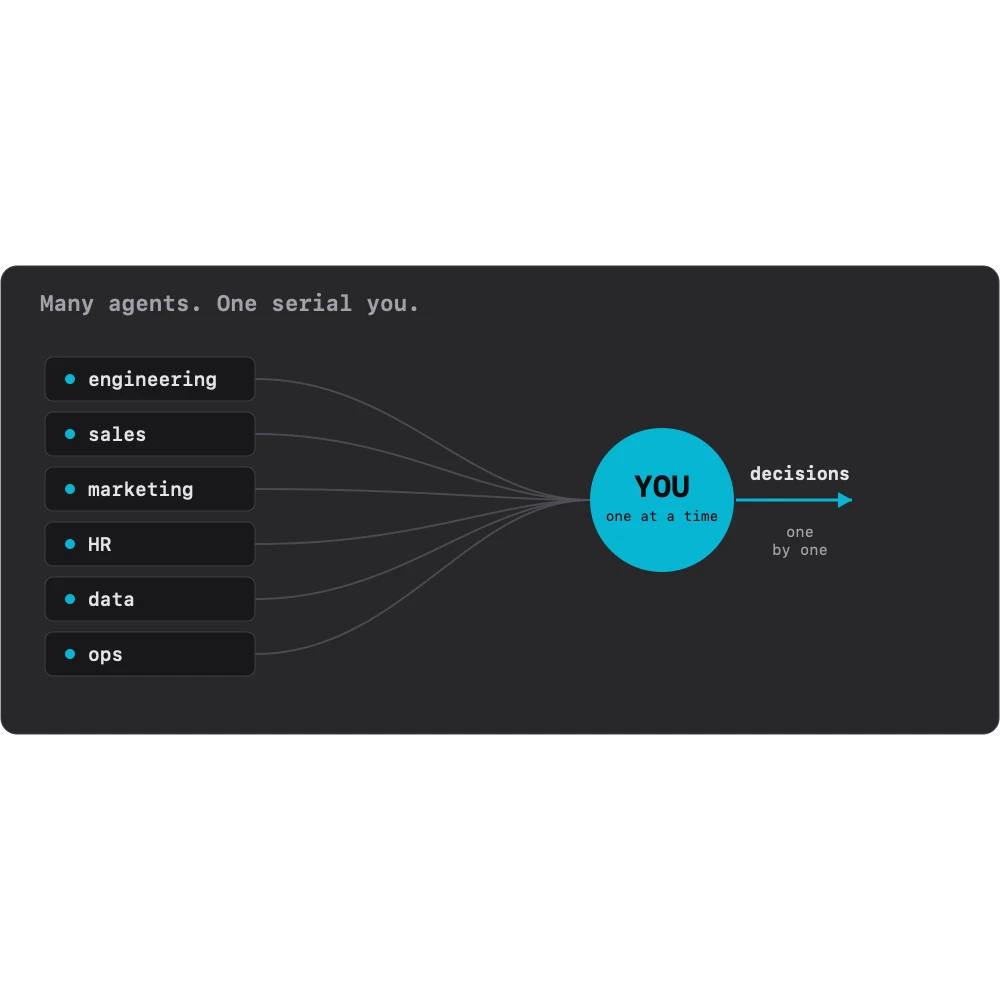
The Human Is the New Bottleneck
AI didn't make me faster. It made me the bottleneck. Running five to twenty agents across every function of my company, the slowest part of the whole thing is the one part I can't optimize away: me.
Read more →